

Richard Stearns wrote a popular Christian book titled – The Hole in our Gospel. The book condemns the type of Christian whose Christianity doesn’t extend beyond sitting in Sunday church service. There are several excellent points the book makes. I’m not rebutting the book in this post, but rather I’m responding to a perspective I’ve encountered in short-term missionaries based on their interpretation of works like The Hole in our Gospel. If you are interested in an excellent critique of Mr. Stearn’s book, read this post by Kevin DeYoung at The Gospel Coalition – https://www.thegospelcoalition.org/blogs/kevin-deyoung/a-hole-in-our-gospel/
Churches in the West crave measurable data. Every missionary can testify about letters they’ve received from supporters asking things like – How many churches have you planted? How many converts have you won? How many members do you have in your churches? This just isn’t how the Kingdom of Heaven has ever operated since it was brought down to us. The reality is, I’ve thought people were saved who later by actions revealed they didn’t know Christ. There are others who were rebellious and even enemies of ours for years before God did a work in their heart and they now serve him. Jesus spent 3 years in ministry majorly wrapped up in dialogue with 12 men (one of whom would betray him). Even those men didn’t believe him when he repeatedly revealed he would be crucified and rise again on the 3rd day. In John 6, when Jesus had gathered perhaps the largest crowd he ever had at a single time, he promptly sent his disciples in a boat across the sea and hid himself from the people. Jesus described the Kingdom of Heaven in this way, Matthew 13:31-33, “He put another parable before them, saying, the kingdom of heaven is like a grain of mustard seed that a man took and sowed in his field. It is the smallest of all seeds, but when it has grown it is larger than all the garden plants and becomes a tree, so that the birds of the air come and make nests in its branches. He told them another parable. The kingdom of heaven is like leaven that a woman took and hid in three measures of flour, till it was all leavened.” God’s kingdom grows quietly over a long period of time. The outcome is unmistakable, but the process is not always so visible.
What is the gospel about? The famous prosperity teacher, Jesse Duplantis, once said “Jesus’ primary objective was to eliminate poverty.” Scripture resoundingly disagrees with this statement. Jesus told us “give to everyone who begs from you, and from one who takes away your goods do not demand them back.” That’s a recipe for extortion, not a way to get rich. James asks us “hasn’t God chosen the poor of this world rich in faith?” Is the gospel about improving people’s morality? Well, the Bible says that no person is good (Romans 3:10-12). Is it about making sick people healthy? Consider this story from the life of Paul – 2 Corinthians 12:7-10 “And by reason of the exceeding greatness of the revelations, that I should not be exalted overmuch, there was given to me a thorn in the flesh, a messenger of Satan to buffet me, that I should not be exalted overmuch. Concerning this thing I besought the Lord thrice, that it might depart from me. And he hath said unto me, My grace is sufficient for thee: for my power is made perfect in weakness. Most gladly therefore will I rather glory in my weaknesses, that the power of Christ may rest upon me. Wherefore I take pleasure in weaknesses, in injuries, in necessities, in persecutions, in distresses, for Christ’s sake: for when I am weak, then am I strong” (ASV). So, what is the gospel about?
The gospel is not about making poor people rich, or sick people healthy, or bad people good, it’s about making dead people live – John 5:24-25 “Truly, truly, I say to you, whoever hears my word and believes him who sent me has eternal life. He does not come into judgment, but has passed from death to life. Truly, truly, I say to you, an hour is coming, and is now here, when the dead will hear the voice of the Son of God, and those who hear will live” (ESV). Jesus came to deal with sin, specifically to make atonement for it.
Many of the visitors I’ve interacted with at our project and similar projects near us communicate a vision of support that is quite different than the gospel’s. Some people talk about buying solar panels for each mud house in the village. Some suggest educational techniques, small business plans, agricultural methods, and the like while observing life here in Central East Africa. They have diagnosed Africa’s major problem as development. This is the same perspective as the UN, WHO, USAID, and many other humanitarian organizations. I’m sad to say that many Christians see the world the same as a person from a secular perspective. History proves that there is a deeper issue at work. Money has been given to poor people, medicine has been given to sick people, and laws have been legislated for the barbaric. Study the history of aid in the continent of Africa, and you will throw your hands up like many and think, perhaps it would be better if the people who were “helping” quit trying to help.
As one of the directors of a Christian project that seeks to assist impoverished and needy children, I’m not saying we shouldn’t remember the poor. That is part of our Biblical mandate. I’m exhorting us not to lose sight of what each person in this world needs most.
Consider this testimony about Angola prison in Louisiana http://www.bpnews.net/27125/warden-saw-only-one-answer-for-troubled-la-prison-christ. I encourage you to read the whole article as it’s very encouraging and enlightening.
I’ve read that before Warden Cain took over leadership, Angola prison was so dangerous that each prisoner was given a knife upon entry for protection. The most violent criminals were sent there, and it had the largest percentage of death row inmates of any prison in the United Sates. Mr. Cain, a Bible-believing Christian, made some reforms. He put Bibles into each prison cell and organized evangelistic efforts. Here is an excerpt from the article about some of the prison’s accomplishments –
”A Southern Baptist, Cain invited New Orleans Baptist Theological Seminary to launch a rigorous four-year college extension course for inmates who desired a college degree. The program is funded largely by private donations.
Every weekday, more than 100 men crowd into classrooms in a prison building to study the Bible and to take courses toward a college degree, accredited the same as one from Louisiana State University. Cain also began a certificate program for faith-based education, aimed at inmates who didn’t have a high school diploma or its GED equivalent. More than 100 inmates earned their certificate in 2006.
Each year, inmate seminary graduates who feel called to ministry are transferred “two by two” to other prisons in Louisiana to serve as inmate missionaries. They receive no special favors or time reduced from their sentences; they choose to serve God by sharing the Gospel with other inmates like no one else can.
The missionaries carry what they learned in seminary into the prisons’ living areas to help men “experience God.” In one year alone, they baptized more than 150 prisoners and averaged more than 15,000 evangelistic contacts a month throughout the state’s correctional system.
Cain raised corrections officers’ wages and instituted vocational training for the inmates. The prison’s standard of living “shot through the roof,” said one officer. Cain also started public speaking courses to prepare inmates to better communicate with others. The prison’s radio station, JSLP at 91.7FM, is endearingly called the “incarceration station.” Staffed by inmates, the station evangelizes by broadcasting uplifting music and sermons 24 hours a day.
As Cain shared what God was doing at Angola, his message prompted private donors to build more chapels on the prison grounds and to support the growing ministry programs.
While Angola is still very much a prison, the violent death rate has declined significantly, along with rapes, drug use and assaults on guards. It is largely due to the seminary inmates living and mingling among the rest of the population, observers note. Inmates can now be found holding prayer services in the yards, in their dormitories and on the work sites. Praise and worship services in the chapels are Holy Spirit-filled and rock with heart-felt gospel music from the inmate musicians and choirs.”
Ravi Zacharias, who has visited and preached to the inmates at Angola more than once, shared this conversation he once had with an inmate who was serving life imprisonment there. Ravi asked the inmate if he was ever discouraged knowing he would never be able to be free again. The inmate responded by saying sir, I never knew what it was to be free until I came to know Jesus Christ inside these prison walls, and I’m freer now than I’ve ever been before. Then he asked Ravi to pray for his family members. He said they don’t know Jesus yet and even though they are outside these walls, they are the ones who are truly in prison.
Paul spoke of a similar transformation story among the Corinthian believers – “Or do you not know that the unrighteous will not inherit the kingdom of God? Do not be deceived: neither the sexually immoral, nor idolaters, nor adulterers, nor men who practice homosexuality, nor thieves, nor the greedy, nor drunkards, nor revilers, nor swindlers will inherit the kingdom of God. And such were some of you. But you were washed, you were sanctified, you were justified in the name of the Lord Jesus Christ and by the Spirit of our God” 1 Corinthians 6:9-11 ESV.
Jesus never claimed he would fix this world. This world is going to pass away – 2 Peter 2:7 “But by the same word the heavens and earth that now exist are stored up for fire, being kept until the day of judgment and destruction of the ungodly.” Jesus came to save us from this world – 2 Peter 2:9 “The Lord is not slow to fulfill his promise as some count slowness, but is patient toward you, not wishing that any should perish, but that all should reach repentance.”
There may be holes in our obedience to the gospel, but there is no hole in the gospel. If you are not active in your Christianity, scripture condemns you. But our actions must center around the gospel. That’s what people need. I spoke at a new church deep in the interior village beyond Lubumba. They arranged for me to teach from 11-6, but a neighbor in their community passed away, so I taught until 3:30. I asked, as I always do when teaching a new audience, what is the greatest need you have in life? A man named Battle raised his hand and said, “I must have eternal life.” The congregation is poor, living among other impoverished families. The area is going through a drought, which affects the believers as much as everyone else. But the believers have joy, where the lost have despair, because the believers have “the outcome of their faith, the salvation of their souls.”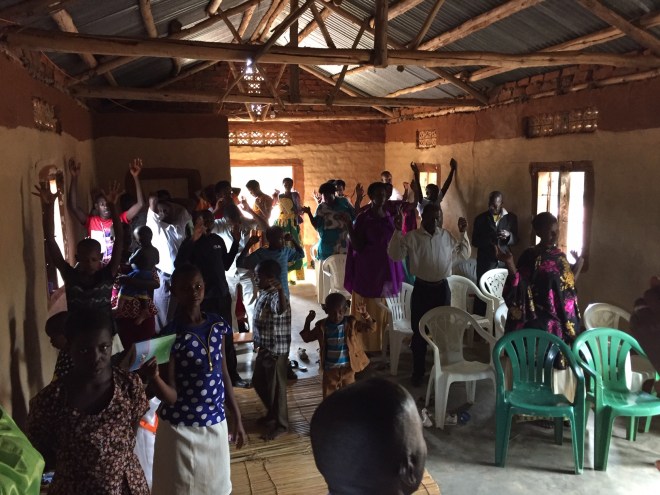


Very challenging and encouraging to hear! Thank you for the message.
LikeLike